
 Assistant
Big Five Personality Traits Explained: What They Reveal About You
 Daniel Harper
Summary: This article explains the Big Five Personality Traits (OCEAN) and what each trait reveals about your personality. Learn how these five dimensions shape behavior and self-understanding.
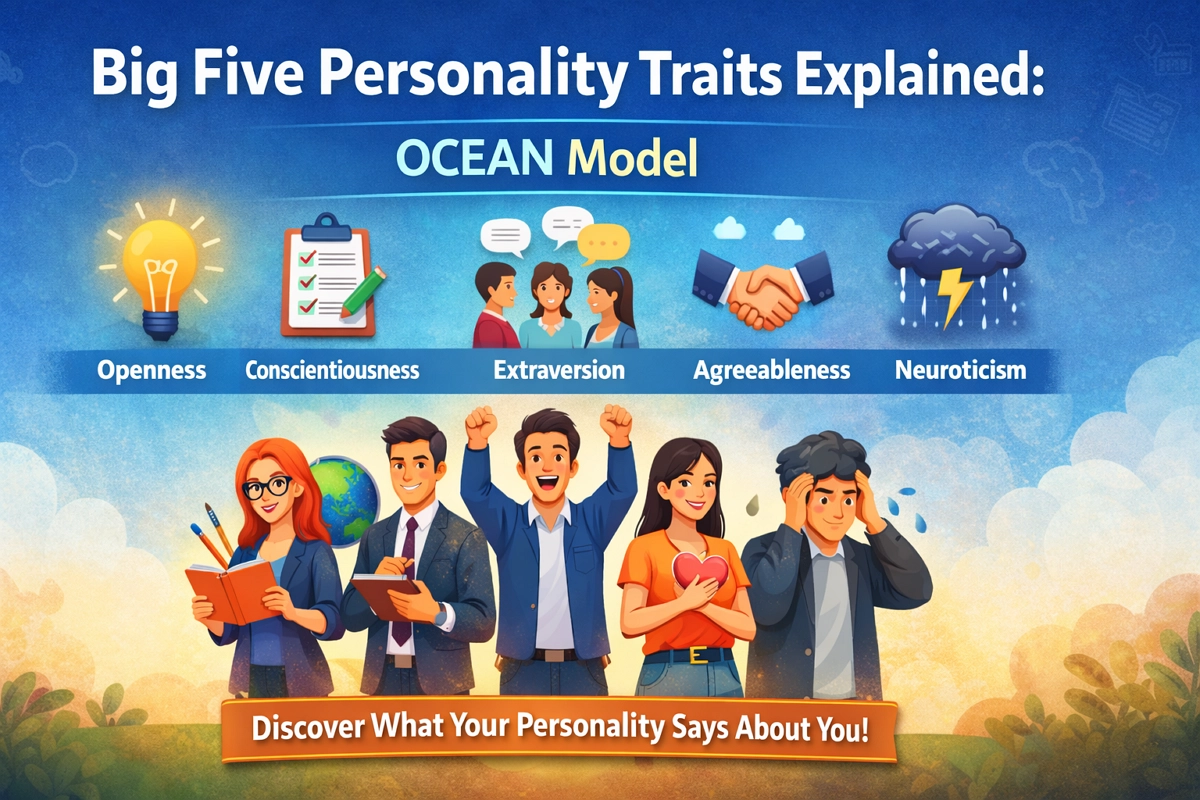
Understanding your personality can help you make better decisions about relationships, career paths, and personal growth. Among the most widely accepted models in psychology is the Big Five Personality Traits, also known as the OCEAN model.
Unlike some personality frameworks that categorize people into types, the Big Five measures personality along five broad dimensions, giving a more flexible and scientific view of who you are.
In this guide, we'll explain what the Big Five traits are, what they mean, and how they shape your behavior in everyday life.
What Are the Big Five Personality Traits?
The Big Five personality model is a psychological framework that describes personality using five major dimensions:
- Openness to Experience
- Conscientiousness
- Extraversion
- Agreeableness
- Neuroticism
These traits form the acronym OCEAN.
The Big Five measures how strongly each trait appears in your personality. For example, someone may be highly conscientious but moderately introverted.
Big Five Personality Traits Chart
| Trait | High Score Traits | Low Score Traits |
|---|---|---|
| Openness | Creative, curious, imaginative | Practical, traditional |
| Conscientiousness | Organized, disciplined, reliable | Flexible, spontaneous |
| Extraversion | Social, energetic, talkative | Reserved, reflective |
| Agreeableness | Compassionate, cooperative | Competitive, direct |
| Neuroticism | Emotionally sensitive, anxious | Calm, emotionally stable |
This chart shows how each Big Five dimension represents a spectrum of personality traits, rather than fixed categories.
The 5 Big Five Personality Traits Explained
1. Openness to Experience
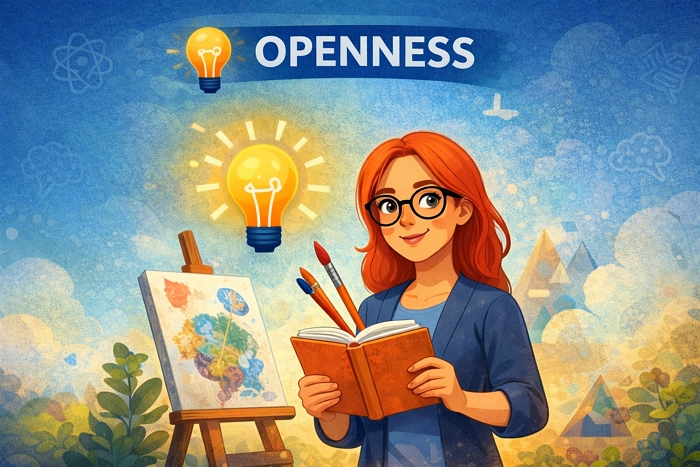
Openness reflects how curious, imaginative, and open-minded a person is.
People with high openness tend to enjoy new ideas, creativity, and exploration. They are often drawn to art, philosophy, travel, and abstract thinking.
People with low openness usually prefer familiarity, practical thinking, and clear structures.
High Openness Traits
- Curious about new ideas
- Creative and imaginative
- Enjoy art, music, and culture
- Comfortable with change
Low Openness Traits
- Prefer routine and tradition
- Practical and realistic
- Less interested in abstract concepts
Openness often influences learning style, creativity, and adaptability.
2. Conscientiousness
Conscientiousness describes how organized, disciplined, and goal-oriented someone is.People high in conscientiousness are usually reliable, hardworking, and careful planners.Those lower in this trait may be more spontaneous, flexible, or less structured.

High Conscientiousness Traits
- Organized and detail-oriented
- Responsible and dependable
- Strong self-discipline
- Good at long-term planning
Low Conscientiousness Traits
- More relaxed about schedules
- Prefer flexibility over strict plans
- May procrastinate more often
Research shows that conscientiousness is strongly related to career success and academic performance.
3. Extraversion
Extraversion measures how socially energetic and outgoing someone is.Highly extraverted people gain energy from interacting with others, while introverted individuals may prefer quieter environments and deeper one-on-one conversations.
High Extraversion Traits
- Talkative and energetic
- Enjoy social gatherings
- Comfortable being the center of attention
- Often feel energized by people
Low Extraversion (Introversion)
- Prefer smaller social circles
- Enjoy solitude or quiet activities
- Reflective and thoughtful
Extraversion often influences social behavior, communication style, and leadership preferences.
4. Agreeableness
Agreeableness reflects how cooperative, compassionate, and trusting someone is toward others.People high in agreeableness often prioritize harmony and relationships.Those lower in this trait may be more competitive, skeptical, or direct.
High Agreeableness Traits
- Empathetic and supportive
- Cooperative in group settings
- Value harmony and kindness
Low Agreeableness Traits
- More competitive or blunt
- Less concerned with social harmony
- Strongly independent in decision-making
Agreeableness can affect teamwork, relationships, and conflict resolution.
5. Neuroticism
Neuroticism describes emotional sensitivity and how strongly people experience negative emotions like anxiety or stress.High neuroticism does not mean something is "wrong" with a person—it simply reflects greater emotional responsiveness.
High Neuroticism Traits
- Emotionally sensitive
- Prone to stress or worry
- Strong reactions to challenges
Low Neuroticism Traits
- Calm under pressure
- Emotionally stable
- Less likely to experience mood swings
Understanding this trait can help you manage stress and emotional well-being more effectively.
How the Big Five Traits Work Together
Most people are a unique combination of all five traits rather than extremely high or low in just one.
For example:
- Someone may be high in openness and introverted, making them reflective and creative.
- Another person might be high in extraversion and agreeableness, making them socially warm and outgoing.
These combinations influence how we:
- communicate
- make decisions
- respond to stress
- build relationships
That's why personality assessments often measure all five traits together.
Big Five vs MBTI: What's the Difference?
Many people compare the Big Five personality traits with the 16 Personality Types (MBTI). While both explore personality, they approach it in different ways.
The Big Five, also known as the Big Five personality traits or OCEAN model, measures personality along five continuous traits. In contrast, MBTI groups people into distinct personality types based on four preference pairs.
| Feature | Big Five Model | MBTI (16 Personalities) |
|---|---|---|
| Structure | Trait-base spectrum | Personality types |
| Dimensions | 5 traits | 4 dichotomies |
| Scientific Research | Strong academic support | More popular in self-development |
| Result Format | Trait scores across five dimensions | Personality type (e.g., INFJ, ENFP) |
The Big Five focuses on measurable personality traits, while MBTI provides easier-to-understand personality identities.
Why Understanding Your Personality Matters
Learning about your personality traits can help you:
- Choose careers that match your strengths
- Improve communication with others
- Understand your emotional patterns
- Develop better personal habits
Self-awareness is often the first step toward personal growth and better relationships.
Discover Your Big Five Personality Profile
Curious about where you fall on the Big Five spectrum?
Take the Big Five Personality Test on Myfunquiz to discover your unique personality profile. The test measures your levels of Openness, Conscientiousness, Extraversion, Agreeableness, and Neuroticism, giving you a clearer picture of how your personality works.
You can also explore other assessments like:
- 16 Personality Test
- IQ Test
- Career Test
Together, these tests help you complete the full puzzle of your personality.
Conclusion
The Big Five Personality Traits provide a powerful framework for understanding human behavior. It reveals the unique balance of traits that shape how you think, feel, and interact with the world.
If you want to explore your personality more deeply, start by taking the Big Five Personality Test and see what your results reveal about you.
Your personality is complex—and discovering it can be the beginning of a fascinating journey.
Big Five Personality FAQs
1. Is the Big Five personality model scientific?
Yes. The Big Five is considered one of the most scientifically supported personality models in modern psychology and is widely used in academic research.
2. What does OCEAN stand for?
OCEAN stands for:
- Openness
- Conscientiousness
- Extraversion
- Agreeableness
- Neuroticism
3. Can the Big Five personality traits change over time?
Personality traits tend to remain relatively stable, but research suggests they can gradually change with age, life experiences, and personal development.


